
The Role of Chisels and Gouges in Luthiery
Chisels and gouges are primarily used for controlled, manual shaping and fine carving of wood. They are essential for tasks that require a high degree of craftsmanship, such as hollowing out the inside of an acoustic guitar or mandolin body, shaping the contours of necks, cutting precise joints, and performing intricate detailing like binding channels. Unlike saws, which are primarily used for cutting along straight lines, chisels and gouges excel at removing wood in a controlled manner, allowing for fine, smooth curves, edges, and even detailed textures.
These tools allow luthiers to work with precision and flexibility, especially when performing delicate tasks that require an expert touch. They provide a level of control that power tools cannot always match, making them indispensable for high-end, custom, or repair work.
Types of Chisels and Gouges Used in Luthiery
Flat Chisels

Flat chisels are the most common type of chisel and are used for removing wood in flat, straight lines or for refining smooth, flat surfaces. They have a rectangular or square blade edge that allows for efficient removal of wood when worked at various angles.
- Uses:
- Smoothing surfaces, especially on the sides or back of an instrument.
- Creating flat surfaces for precise joins, such as neck-to-body joints on guitars.
- Trimming and fine-tuning edges where a perfectly flat edge is needed.
A flat chisel’s simplicity and versatility make it one of the most essential tools in a luthier’s kit, particularly when shaping the overall body of the instrument or smoothing areas after sawing.
Bevel-Edge Chisels
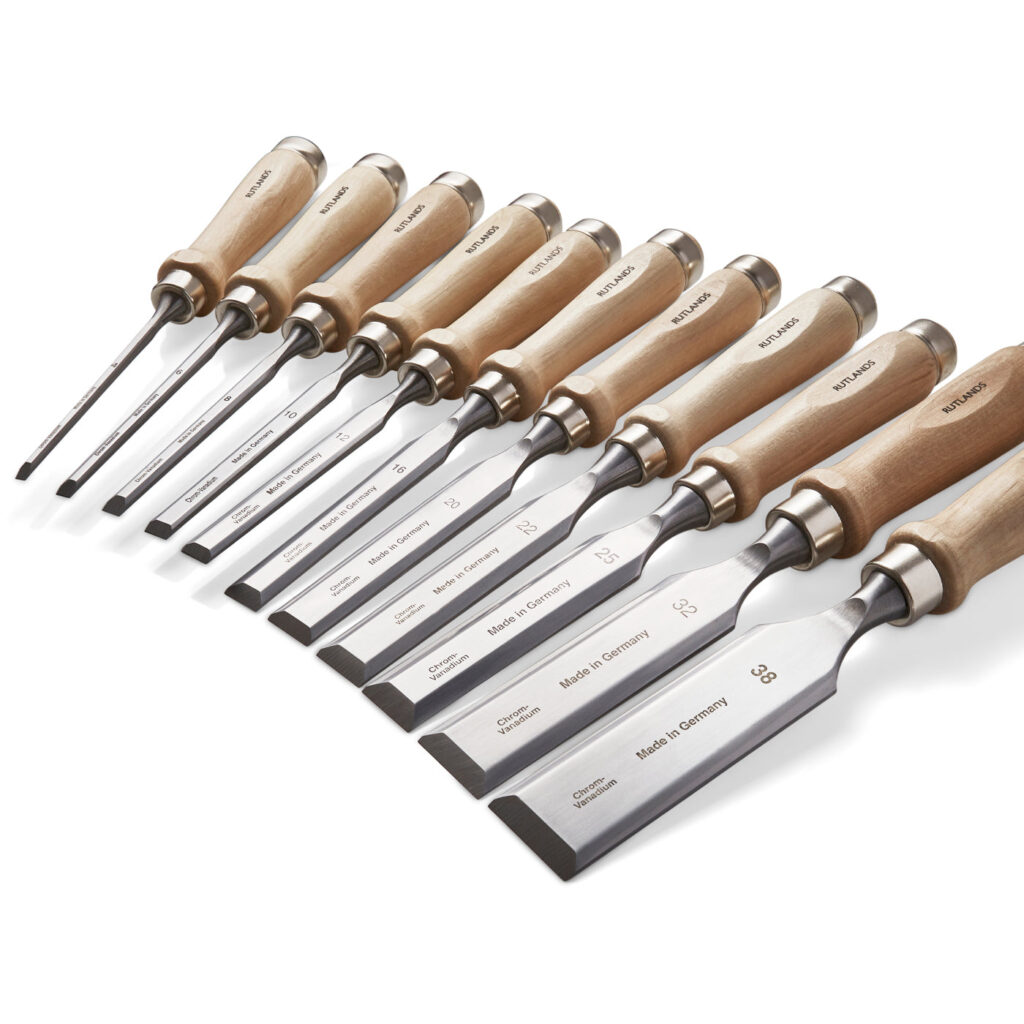
A bevel-edge chisel is similar to a flat chisel but has an angled bevel on the sides, allowing for easier access to tight corners and delicate spaces. The bevel-edge chisel is preferred when working in confined areas or when a more precise cut is required along the edge of a piece of wood.
- Uses:
- Carving fine details around fingerboard edges, scrolls, or other intricate areas of the instrument.
- Creating precise grooves or chamfers in neck joints or body contours.
- Working on tight areas where a standard flat chisel would be too wide.
Bevel-edge chisels are especially favored when shaping the curves and detailing the finer aspects of an instrument’s neck or body.
Gouges
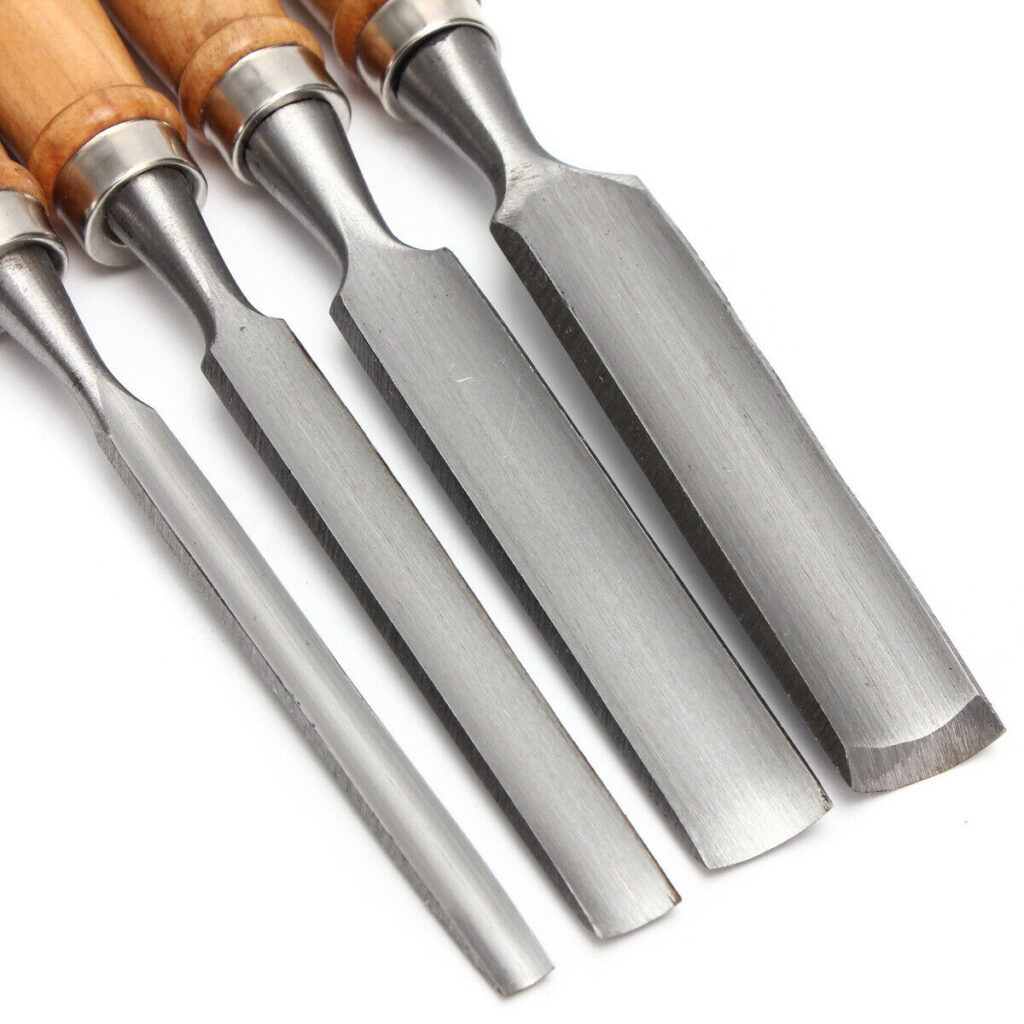
Gouges are chisels with a curved cutting edge, which makes them indispensable for hollowing, shaping, and carving complex curves or concave surfaces. There are many variations of gouges, with different degrees of curvature, ranging from shallow curves to deeper, more pronounced curves. Gouges are crucial in instruments like violins, cellos, and guitars, where carving the body or shaping contours requires a more sculptural approach.
- Uses:
- Hollowing out the inside of a violin, guitar, or mandolin body (often referred to as “voicing”).
- Shaping the internal curves of necks and headstocks.
- Carving decorative elements such as scrolls, binding channels, or intricate inlay work.
Gouges excel at providing a smooth, controlled cut in both convex and concave surfaces, which makes them an indispensable tool for the luthier working on detailed wood carving.
V-Gouges
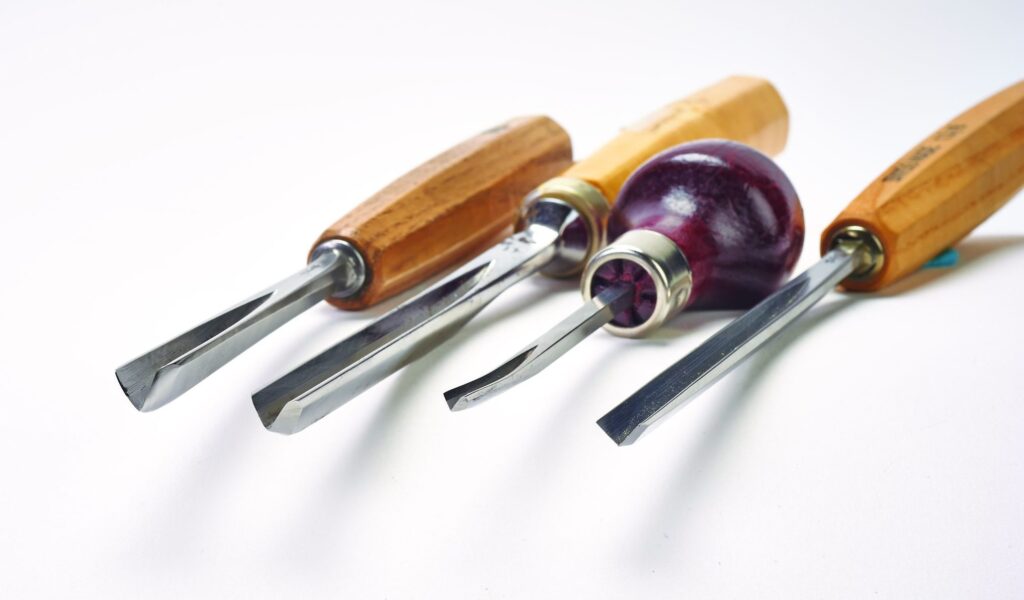
A V-gouge has a V-shaped cutting edge and is used for making deep, sharp grooves and lines. The narrow profile of a V-gouge allows for very controlled and detailed carving work, which is particularly useful for adding decorative accents and intricate designs.
- Uses:
- Carving fine lines for decorative inlays or fretboard markers.
- Creating the grooves for binding or purfling inlays on the edges of the instrument body.
- Detailing intricate patterns, such as decorative carvings along the body or headstock.
V-gouges are particularly popular for tasks involving precise, sharp lines and can help create elegant, detailed designs without disrupting the surrounding wood.
Round Gouges

Round gouges are a subtype of gouges with a fully rounded edge. These are used for carving deeper, concave curves and are particularly valuable for shaping hollow areas such as the inside of an acoustic guitar or violin top.
- Uses:
- Shaping the body of an instrument, particularly in hollowing out the interior (such as the carved tops and backs of violins or guitars).
- Working in areas where a continuous, deep, curved surface needs to be shaped smoothly and evenly.
- Carving flutes and other woodwind instruments, where curved channels are required.
The round gouge’s ability to carve deep, smooth, and even curves makes it a vital tool for hollowing wood in a controlled manner, ensuring the smoothness and consistency of the shape.
Key Factors When Choosing Chisels & Gouges
When selecting chisels and gouges, there are several factors that luthiers must take into account to ensure that the tool meets their needs for precision and durability:
Blade Material
Chisels and gouges are often made from high-carbon steel or laminated steel. High-carbon steel is known for its sharpness and ability to retain an edge, but it is more prone to rusting and requires more maintenance. Laminated steel offers increased durability, with a core of harder steel sandwiched between two softer layers. This combination provides a longer-lasting edge and is less likely to chip or wear quickly.
Handle Material
The handle material is equally important, as it must be comfortable to hold for long periods and provide enough leverage for controlled carving. Traditional luthier tools feature handles made of hardwoods such as beech, maple, or ash, which are both strong and offer a good grip. Some modern chisels and gouges have ergonomic handles or synthetic grips designed for comfort and durability.
Edge Angle
The angle of the cutting edge affects the sharpness and the type of cut produced. A higher-angle bevel (typically around 25° to 30°) provides a more durable edge suitable for tougher woods but requires more force to cut. A lower-angle bevel (around 15° to 20°) provides a sharper cut but is more prone to dulling. The ideal angle depends on the luthier’s work style and the specific task at hand.
Curvature and Size
The curvature and size of the gouge’s cutting edge determine how it can be used. Larger gouges with a shallower curve are useful for broader cuts, while smaller gouges with a deeper curve are ideal for detailed and more delicate carving. Luthiers often need a variety of gouges in different sizes and shapes to tackle various tasks, from hollowing large areas to working on intricate details.
Maintaining Chisels and Gouges
Maintaining chisels and gouges is crucial to ensure they remain sharp, effective, and durable throughout years of use.
- Sharpening: Chisels and gouges must be regularly sharpened to maintain their cutting performance. A sharpening stone or strop is often used to maintain the blade’s sharpness. For gouges, a specialized sharpening jig can help to maintain the correct angle and curvature.
- Oiling: The wooden handles and metal blades should be regularly oiled to prevent rust and maintain the longevity of the tool.
- Cleaning: After use, cleaning the tools of any debris, sap, or resin build-up helps to keep the blade free from dulling agents that could affect performance.